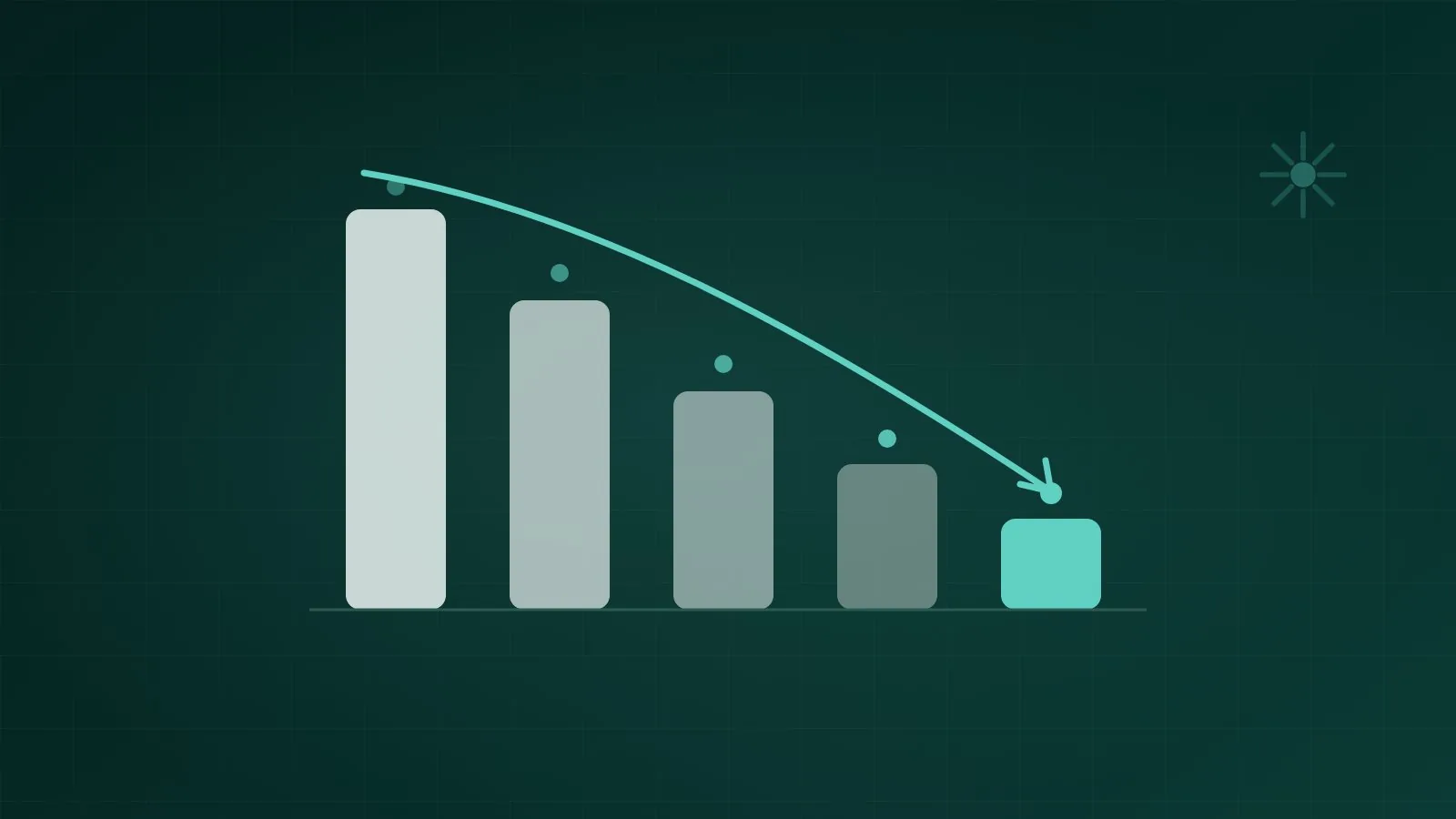
The price of AI capability is falling faster than almost any input cost in business history, and mid-2026 made that impossible to ignore: Anthropic launched Claude Sonnet 5, a near-frontier model, at introductory pricing of $2 per million input tokens, a fraction of what far weaker models cost two years ago. For anyone deciding whether automation is worth it, this changes the arithmetic. The running cost of an AI workflow (the model bill) is collapsing, which means workflows that were uneconomical in 2024 now clearly pay for themselves. This guide covers what actually got cheaper, what falling prices change for business automation, what they emphatically do not change, and how to capture the savings instead of watching them evaporate into waste.
TL;DR
AI model prices keep falling: frontier-class capability now costs a small fraction of its 2023 price, and the trend shows no sign of stopping. That collapses the running cost of automation and makes always-on AI workflows affordable for small teams, but build costs, integrations and scoping do not get cheaper because tokens do. Capture the savings with narrow scope and model routing; do not use them as an excuse to automate carelessly.
- What fell: the per-token price of any given capability level, dramatically and repeatedly
- What it changes: workflows that failed the ROI test in 2024 now clearly pass it
- What it doesn't change: build cost, data readiness, integrations, and the need for guardrails
- How to capture it: model routing, cost per outcome, and revisiting your model choices quarterly
By the numbers
$2/M
introductory input-token price of Claude Sonnet 5 (June 2026), a near-frontier model, undercutting its own predecessor. PYMNTS
280x
drop in the cost of GPT-3.5-level inference between late 2022 and late 2024, and the curve has continued since. Stanford HAI
40%+
of agentic AI projects still expected to be canceled by end of 2027; cheap tokens do not rescue bad scoping. Deloitte
Industry figures are cited for context; outcomes vary by business and implementation.
What actually got cheaper
Be precise about the claim, because it is stronger than "prices dropped". What keeps falling is the price of a given level of capability. The quality of answer that required the most expensive model on the market in 2023 is now available from mid-tier models at pennies; the frontier models of today launch at prices below what last year's mid-tier charged. Stanford's AI Index measured a 280-fold fall in the cost of GPT-3.5-level inference in just two years, and 2026 has continued the pattern: this summer's headline launch arrived at $2 per million input tokens with performance close to models three times its price. One honest caveat: vendors change tokenizers and usage grows as you automate more, so your bill falls slower than the per-token price does. The direction, though, is unambiguous.
Why prices keep falling
Three forces compound. Competition: half a dozen serious model providers are fighting for developers, and price is a weapon; introductory discounts on new frontier models are now standard. Efficiency: inference hardware and serving software improve every quarter, so the same answer costs the provider less to produce. Distillation: techniques for compressing big-model capability into small models keep improving, which means yesterday's flagship intelligence ships in today's budget tier. None of these forces is close to exhausted, which is why planning your automation economics around today's prices is actually conservative.
What this changes for business automation
The model bill used to be a real line item in automation ROI. Increasingly, it is a rounding error, and that redraws the map of what is worth automating.
- Marginal workflows now clear the bar: jobs that generated too little value per run to justify 2024 model prices (triaging every email, enriching every lead, QA-checking every reply) are now comfortably economical
- Always-on agents fit small budgets: the monthly running cost of a scoped agent has fallen to the point where a one-person business can afford one, not just an enterprise
- Multi-step systems stop being scary: orchestrated workflows make dozens of model calls per outcome; at current prices, even those add up to less than the manual minutes they replace
- Volume stops being the constraint: processing every record instead of a sample is no longer a cost decision
What falling prices do not change
Here is the discipline part. The cost of an automation project was never mostly tokens. It is the integrations into your systems, the process design, the state of your data, and the guardrails that keep the thing trustworthy, and none of that gets cheaper because inference did. That is why analysts still expect over 40% of agentic AI projects to be canceled by the end of 2027: unanticipated costs and unclear value, not model bills. The full breakdown in our guide to what an AI agent costs still holds; falling prices shrink the "running costs" column and leave the rest intact. Cheap tokens make a well-scoped project more profitable. They make a badly scoped project fail slightly less expensively. For what our own automation work starts at, quoted in Pakistani rupees, see our service price list.
How to actually capture the savings
Falling prices reward businesses that treat model spend as an engineering decision. Route by difficulty: send routine steps (classify, extract, summarize) to small cheap models and reserve frontier models for judgment calls; this is standard practice in the agents we build and routinely cuts model spend far below a one-model setup. Measure cost per outcome, not cost per call: the number that matters is what a resolved ticket or a processed lead costs end to end. Revisit quarterly: the best-value model changes several times a year, so a system pinned to one vendor's one model silently overpays. That is part of why managed AI retainers earn their keep. And keep scope tight anyway: the point of cheaper AI is a faster payback on a good automation, not permission to build a sprawling one.
Bottom line: the running cost of automation is collapsing and will keep collapsing, which makes now, not some cheaper future, the right time to automate a well-chosen workflow. Scope narrow, route smart, measure per outcome, and let the price curve work for you.
Frequently asked questions
Why are AI model prices falling?
Three forces compound: fierce competition between model providers, rapid efficiency gains in hardware and inference software, and smaller models that now match what only the largest models could do a year earlier. The result is that the price of a given level of AI capability has dropped dramatically year over year, and providers keep launching more capable models at lower prices to win developers.
Do falling AI prices make automation projects cheaper overall?
Running costs, yes: the monthly model bill for the same workload keeps shrinking. Build costs, mostly no: the price of an automation project is driven by integrations, process design, data readiness and guardrails, and none of those get cheaper because tokens do. Falling prices improve the ongoing ROI; they do not rescue a badly scoped build.
Should I wait for AI prices to drop further before automating?
No. The model bill is usually the smallest line in an automation budget, so waiting saves little while the manual work you have not automated keeps costing you every month. A better strategy is to automate a narrow, high-value workflow now and let the falling price curve compound your return over time.
What is model routing and why does it matter for costs?
Model routing means sending each step of a workflow to the cheapest model that can do it reliably: small, fast models for routine steps like classification and extraction, and frontier models only for the genuinely hard steps. Well-routed systems often cut model spend dramatically versus sending everything to one premium model, with no loss in output quality.