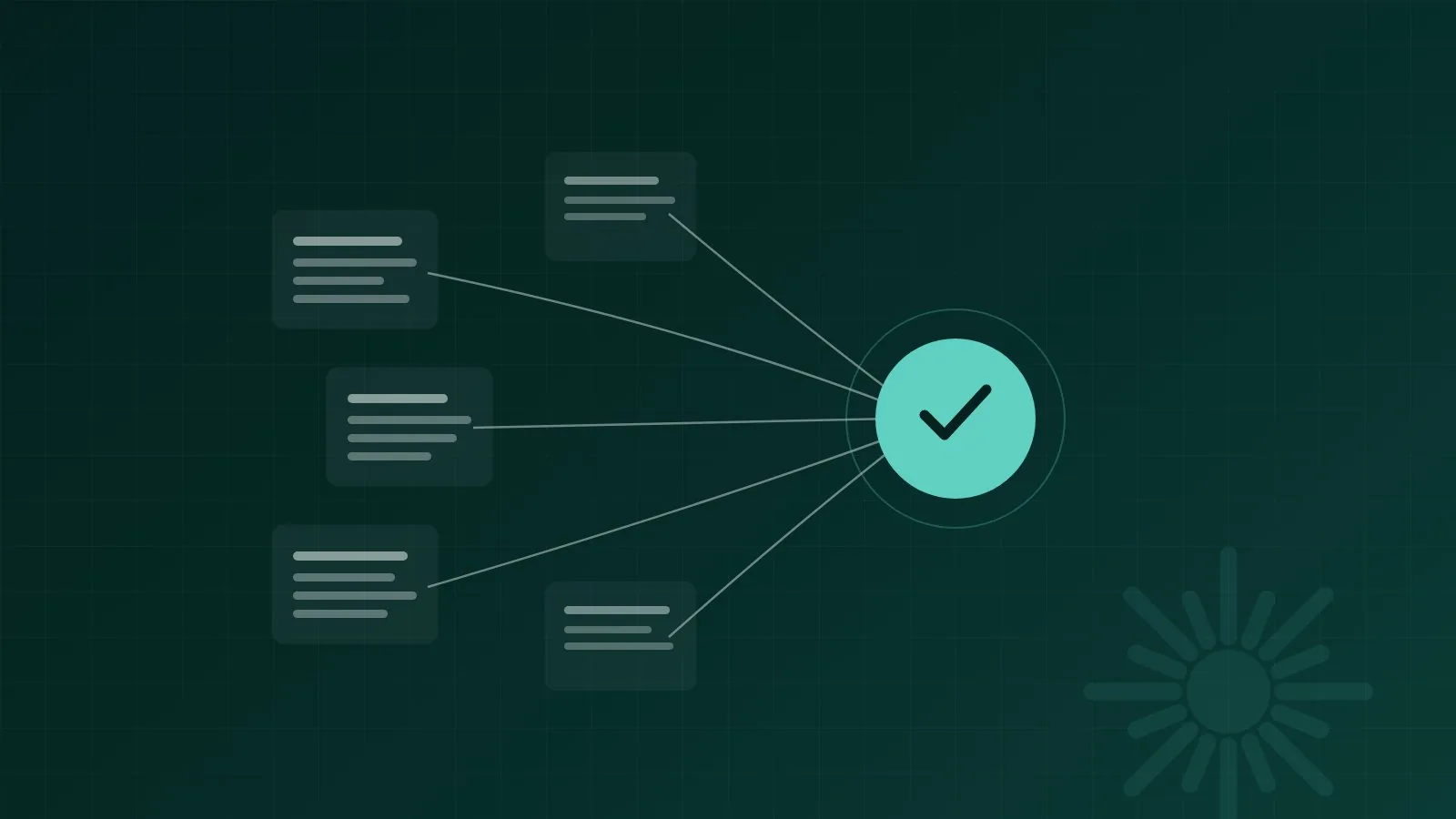
An AI that knows your business does not answer from a generic model's memory; it answers from your own documents, at the moment you ask, with the source attached. The technique behind it is retrieval-augmented generation (RAG): the system finds the most relevant passages in your knowledge, hands them to the model, and asks it to answer from those passages alone. This matters more in 2026 than it did a year ago, because the gap between companies getting value from AI and companies stuck in pilots has turned out to be less about the model and more about whether the model can see the business. An MIT study widely reported this year found that 95% of enterprise generative-AI pilots delivered no measurable profit impact, and the projects that did work were the ones grounded in real context and workflows rather than generic chat. This guide explains what grounding actually means, why generic AI keeps getting your business wrong, and how to put an assistant that cites your real sources into production without a year-long data project first.
TL;DR
Retrieval-augmented generation makes AI answer from your own approved documents instead of guessing from general training. It retrieves the relevant passages, grounds the answer in them, and shows its sources. That turns a confident-sounding chatbot into an assistant that is actually right about your prices, policies, and products, and it is the difference most stuck AI pilots are missing.
- The problem: generic AI has never read your business and has a fixed knowledge cutoff
- The fix: retrieve from your own sources at question time, then answer from those
- The proof: every answer carries a citation you can click and check
- Start small: one clean, high-value document set beats a giant messy archive
By the numbers
95%
of enterprise generative-AI pilots delivered no measurable profit-and-loss impact, an MIT study reported in 2025. MIT
80%
of GenAI business apps will be built on organizations' existing data management platforms by 2028, grounding AI in your own data. Gartner
~1/3
of organizations using generative AI have scaled it beyond pilots to real value; usage is high, value at scale is still rare. McKinsey
Industry figures are cited for context; outcomes vary by business and implementation.
What "AI that knows your business" actually means
A general chatbot is trained on a broad slice of the public internet up to a fixed date. It has never seen your pricing sheet, your refund policy, last week's release notes, or the contract with your biggest client. So when you ask it something specific, it does the only thing it can: it produces the most plausible-sounding answer, whether or not that answer is true for you. Grounding flips this around. Instead of trusting the model's memory, you give it a way to look things up in your own material at the moment of the question, and you instruct it to answer only from what it finds. The model still supplies the language and the reasoning; your business supplies the facts. That is the whole idea behind retrieval-augmented knowledge assistants, and it is why two companies running the same model can get wildly different results.
Why generic AI keeps getting your business wrong
Three things work against an ungrounded model. It has a knowledge cutoff, so anything that changed after training is invisible to it. It has no source of truth, so it cannot tell the difference between your current policy and a plausible-sounding older one. And it is built to always produce an answer, which means when it does not know, it guesses fluently rather than admitting the gap. That last habit is what people call hallucination, and it is most dangerous exactly where it is least obvious: a confident wrong number in a finance answer, or an outdated rule quoted to a customer. Most of what a business actually knows also lives in messy places, documents, email, tickets, PDFs, and slide decks. By Gartner's long-standing estimate, 70% to 90% of an organization's data is unstructured, which is precisely the material a generic model was never given and cannot reach on its own.
How retrieval-augmented generation works
The mechanics are simpler than the acronym suggests. Your documents are indexed so they can be searched by meaning, not just by keyword. When a question comes in, the system retrieves the handful of passages most relevant to it, passes those to the model as the context to work from, and asks for an answer grounded in that context, with references back to the source. Nothing is answered from thin air; every claim can be traced to a document you own.
What good grounding looks like
Grounding is not a switch you flip; it is a set of behaviors you should be able to see in the answers. A well-built knowledge assistant earns trust the same way a good employee does, by being right, being current, and being honest about the edge of what it knows.
- Cites its sources: every substantive answer links back to the document and section it came from, so anyone can verify it in seconds
- Says when it does not know: if your sources do not cover the question, it says so rather than inventing a confident answer
- Stays current: update a policy or price sheet and the next answer reflects it, with no model retraining required
- Respects permissions: it only retrieves from what a given user is allowed to see, so answers never leak restricted material
Where it pays off first
The best first use case is wherever people spend time hunting for answers that already exist somewhere. An internal knowledge assistant that answers staff questions from your policies and playbooks is a common starting point, and it pairs naturally with the personal AI agents businesses are giving employees. Customer support is another: a grounded agent answers only from approved help content and hands off when it is unsure, which is the pattern that actually works rather than a bot that guesses. Grounding is also what makes downstream AI trustworthy, from customer-facing agents to the numbers behind AI data analytics, because an answer is only as good as the source it stands on.
Getting started without a year-long data project
You do not need a perfect data warehouse to begin. Pick one high-value collection of documents that people ask about constantly, clean it up, and ground an assistant on that alone. A small, current, well-organized source set produces better answers than a giant archive full of stale and duplicated files, so the early work is curation, not collection. Add a clear owner who keeps the sources fresh, decide who can see what, and expand only once the first assistant is trusted. This is where a managed knowledge base earns its place: someone owns retrieval quality, source freshness, and permissions, so the assistant stays accurate as your business changes.
Bottom line: the companies getting real value from AI in 2026 are not the ones with the biggest model. They are the ones whose AI can see their business, answer from it, and show its work. Grounding is what turns a clever demo into a tool your team actually trusts.
Frequently asked questions
What is retrieval-augmented generation (RAG)?
Retrieval-augmented generation is a way of running AI so that it answers from your own approved documents rather than only from a general model's training. When someone asks a question, the system first retrieves the most relevant passages from your knowledge sources, then asks the model to answer using only those passages, and returns the answer with citations to where it came from. The result is an assistant grounded in your business, not the open internet.
How is RAG different from just using ChatGPT?
A general chatbot answers from what it learned during training, which does not include your internal documents, your latest prices, or your policies, and it has a fixed knowledge cutoff. RAG connects the model to your current, authorized sources at the moment of the question, so answers reflect your real data and can point to the exact document behind each claim. It is the difference between an assistant that sounds confident and one that is actually right about your business.
Does RAG stop AI from hallucinating?
It reduces hallucination sharply but does not eliminate it. Because answers are grounded in retrieved passages and carry citations, wrong answers are rarer and much easier to catch. The remaining risk comes from poor retrieval, out-of-date sources, or the model stretching beyond what the passages support, which is why grounding is paired with good source hygiene, clear I-do-not-know behavior, and human review on high-stakes answers.
How much data do we need to start?
Less than most teams expect. A useful knowledge assistant can launch on a single well-chosen document set, such as your support articles, your product manuals, or your internal policies, and expand from there. Quality matters more than volume: a small, clean, current set of sources produces better answers than a huge, messy archive, so the first step is usually choosing one high-value collection rather than gathering everything.